Why Your Hands Hurt More on Cold Gym Mornings
Quick Answer: Cold reduces tissue elasticity and blood flow to the extremities, so the same ball contact produces more discomfort and more bruising. Cold hands also have measurably reduced tactile sensitivity, which degrades passing and setting touch. The fix is a warmup that starts with general body temperature and finishes with graded ball contact, not one that starts with hitting.
The 7am session in an unheated hall is a different sport from the 7pm one. Your hands know it by the second drill.
It is not that you are soft in the morning. Cold tissue behaves differently, and the warmup most teams use does not account for it.

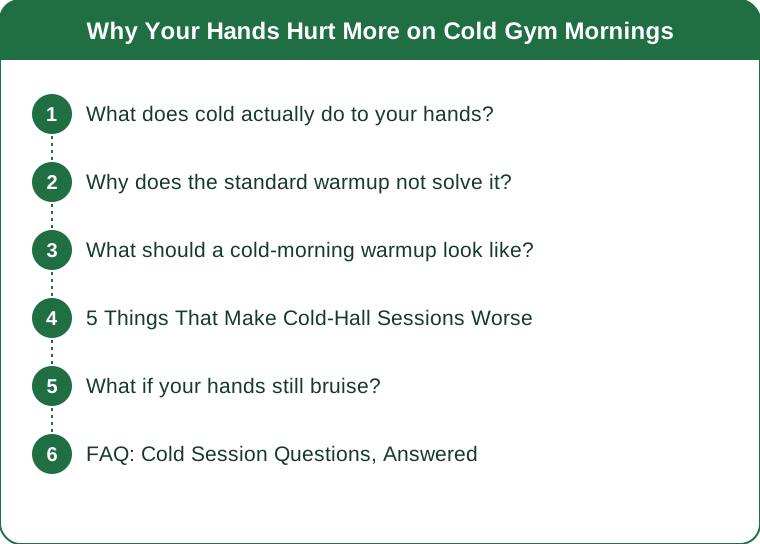
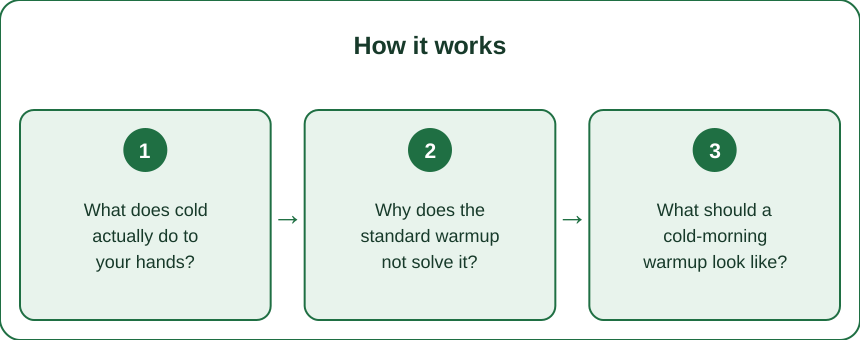
What does cold actually do to your hands?
Three separate effects:
Peripheral vasoconstriction. In cold conditions the body reduces blood flow to the extremities to conserve core temperature. Less blood flow means less warmth, less tissue compliance, and slower clearing of the minor trauma from repeated contact.
Reduced tissue elasticity. Cold tendons and ligaments are stiffer and absorb less energy before transmitting it. The same hard-driven ball delivers more of its force into the joint rather than being absorbed by soft tissue.
Reduced tactile sensitivity. This is the one that affects performance rather than comfort. Cold fingers have measurably worse two-point discrimination and pressure sensitivity, so your setting touch and your read of the ball off the platform are genuinely less precise. You are not imagining that the ball feels different.
The bruising and the touch problems come from the same cause and they respond to the same fix.
Why does the standard warmup not solve it?
Because most volleyball warmups go: light jog, some stretching, then pepper, then hitting lines. That sequence warms the legs and the shoulder and skips the hands almost entirely.
Specifically:
- Jogging does little for hand temperature. Peripheral vasodilation follows core temperature rise with a lag, and a five-minute jog in a cold hall is not enough to trigger it.
- Pepper starts with real ball contact. The first firm contact of the session lands on the coldest tissue of the session.
- Hitting lines come too early. Full-speed arm swing on a cold shoulder is a separate risk, and it is usually where the warmup jumps from 40 percent to 100 percent with nothing in between.
The missing element is a graded ramp of ball contact, going from soft and slow to firm and fast, in a hall where the ambient temperature means tissue needs more time than usual.
What should a cold-morning warmup look like?
Twelve to fifteen minutes, structured as a ramp:
Minutes 0 to 4 — raise core temperature. Continuous movement that actually gets you breathing. Jogging, footwork patterns, a few short shuttles. The goal is a genuine temperature rise, not a lap.
Minutes 4 to 7 — extremities. Arm circles, hand shakes, fist clenches, wrist circles. Sounds trivial and it is the step that is always skipped. Rubbing hands together works and there is no reason to be embarrassed about it.
Minutes 7 to 11 — graded ball contact. Start with soft, close-range contacts: gentle setting to a partner at two metres, forearm contacts at low speed. Progress to normal-range pepper. The rule is that no contact should be the hardest one yet by a large margin.
Minutes 11 to 15 — sport specific. Approach work, controlled hitting building to full speed, serve reception at increasing pace.
The key principle is no jumps in intensity, and cold mornings need a slower ramp than evening sessions. If your team’s warmup is the same regardless of the hall temperature, that is the thing to change.
5 Things That Make Cold-Hall Sessions Worse
1. Arriving with cold hands and staying in them. Gloves or pockets on the way in makes a real difference to where you start. Hands that arrive at 20°C warm up much faster than hands that arrive at 10°C.
2. Standing around between drills. Peripheral temperature drops fast when you stop moving in a cold hall. Keep moving between reps, or keep a layer on.
3. Taking layers off too early. Keep long sleeves on through the first half of the warmup. Removing them at the start is the norm and it slows everything down.
4. Starting with serving. Serving is a full-speed shoulder action with a hard contact and it is a common first activity. Move it later in the warmup.
5. Ignoring the ball’s temperature. A ball stored in a cold cupboard is harder and less forgiving than a room-temperature one. Bringing balls out early to sit in the hall, or keeping the warmup balls somewhere warmer, is a genuinely useful trick that almost nobody does.
What if your hands still bruise?
Some of it is technique and cold makes it visible.
Bruising on the forearms usually means contact is happening on the bones rather than the flat of the platform. Cold makes this hurt more, but the contact point is the underlying issue and it is worth having a coach watch a few reps.
Sore finger joints when setting often means contact is too much on the fingertips rather than distributed across the pads. Again, cold amplifies an existing pattern rather than creating it.
Palm heel pain is common when digging hard-driven balls and usually means the hands are being used where the platform should be.
So the diagnostic is useful: whatever hurts most on a cold morning is where your technique has the least margin. Warm evenings hide it. Cold mornings show you exactly what to work on, which is a slightly annoying gift.
This is general information, not medical advice. Persistent joint pain, swelling that does not settle, or any finger injury with deformity needs proper assessment.
FAQ: Cold Session Questions, Answered
Do compression sleeves help?
For warmth, yes — keeping the forearms covered maintains local temperature meaningfully through a session. For impact absorption, the effect is modest. Warmth is the real benefit and it is worth having.
Should I tape my fingers on cold mornings?
Tape is for supporting a specific joint, not for warmth, and taping too tight on cold fingers restricts blood flow further. If you tape routinely, put it on after the hands are warm rather than before.
Why does my serve go long in a cold hall?
Cold air is denser, which changes ball flight slightly, and a cold ball is harder with less grip. Combined with reduced touch, first serves in a cold session are genuinely less predictable. Take a few extra warm-up serves rather than assuming your calibration transferred from last week.
TL;DR:
- Cold causes vasoconstriction, stiffer tissue, and measurably reduced tactile sensitivity in the fingers.
- Standard warmups warm the legs and shoulder and skip the hands entirely.
- Use a ramp: core temperature, then extremities, then graded ball contact from soft and close to firm and fast.
- Whatever hurts most on a cold morning is where your technique has the least margin — treat it as information.
Add three minutes of hand and wrist work before the first ball contact. It is the cheapest change on this list and the one nobody makes.
Keep Reading
This article is for general informational and styling purposes only. Fit, sizing, and product availability may vary.