Why Your Approach Footwork Depends on Which Hand You Hit With
Quick Answer: The last two steps of an approach exist to convert forward speed into upward jump and to set your shoulders square to the ball, and which foot plants last depends on your hitting arm. Right-handed hitters finish left-right-left; left-handed hitters mirror it to right-left-right. Learning the wrong pattern for your arm forces the torso to rotate late, which costs both height and hitting angle, and it is the most common uncorrected fault in recreational play.
Coaches teach one pattern to a whole gym, and half the room quietly compensates for years.
We have covered approach timing, jump serve timing and the vertical jump plateau. This is the one that gets baked in during a first season and rarely revisited.

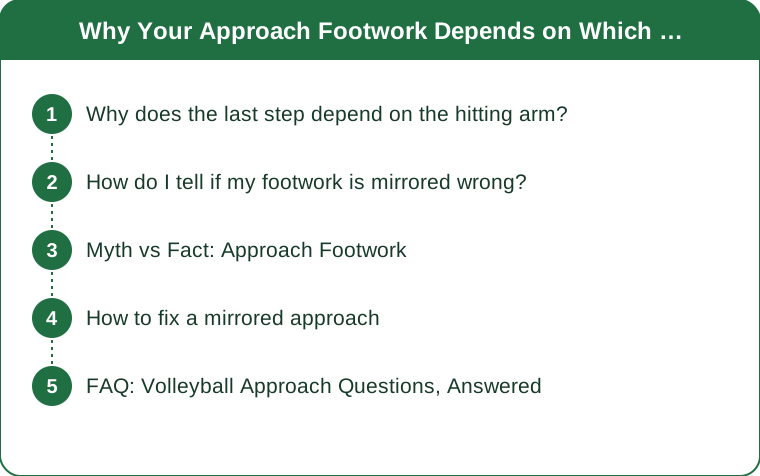
Why does the last step depend on the hitting arm?
Because the approach is setting up a rotation, and the rotation has a direction.
The final two steps are a braking action. They convert horizontal momentum into vertical, which is why the penultimate step is long and low and the last one is short and quick.
They also open the hips and shoulders away from the net. That opening is what lets the hitting arm load behind you rather than beside you.
A right-handed hitter needs the left shoulder toward the net at contact. Finishing left-right-left produces that alignment naturally.
A left-handed hitter needs the mirror image. Right-left-right puts the right shoulder toward the net and lets the left arm load properly.
Using the wrong pattern forces a late correction. The torso has to rotate in the air, which bleeds off vertical momentum and arrives with the shoulders not quite square.
And the tell is directional. A left-hander running a right-hander’s footwork will consistently hit line more easily than cross, and will feel like the ball is always slightly behind them.
How do I tell if my footwork is mirrored wrong?
Three checks, all of which you can do in a normal practice.
Watch where you land relative to where you took off. A correct approach lands you roughly where you jumped, maybe slightly forward. A mirrored one drifts sideways, because the rotation is happening after take-off rather than during the plant.
Notice which angle feels natural. If one hitting angle feels available and the other requires effort, the shoulders are not arriving square.
Check the arm load. Film a few swings from the side. The hitting arm should be behind the body at the top of the jump, not out to the side.
Feel the last step. It should be quick, short and a little wider than the previous one. If it feels like a stumble or a shuffle, the pattern is fighting you.
And listen to the rhythm. A good approach has a long-short cadence at the end, almost a da-DUM. A mirrored one often sounds even, because neither step is doing its job properly.
Left-handed players in particular should check this early, because most drills, most demonstrations and most videos are built around right-handed footwork and nobody thinks to say so.

Myth vs Fact: Approach Footwork
Myth: The approach pattern is universal. Fact: The step sequence mirrors with your hitting arm. Right-handers finish left-right-left; left-handers finish right-left-right. Teaching one pattern to a whole gym leaves left-handers compensating.
Myth: A longer approach means a higher jump. Fact: Beyond three or four steps, extra distance adds horizontal speed that you then have to brake, which usually costs height. What matters is the quality of the last two steps.
Myth: You should jump straight up from the approach. Fact: There is always a small forward component, and trying to eliminate it produces a hesitant plant. The goal is landing near where you took off, not perfectly on the spot.
Myth: Arm swing during the approach is decoration. Fact: The double-arm backswing during the penultimate step contributes meaningfully to jump height. Cutting it short is one of the most common height losses in recreational play.
Myth: If you jump high enough, footwork does not matter. Fact: Footwork determines shoulder alignment, and shoulder alignment determines how many angles are available to you. A high jump with square shoulders and one available angle is easy to defend.
Myth: Changing your approach mid-season is too disruptive. Fact: For most players it takes two or three sessions of slow, no-ball repetition to rewire. The disruption is real and brief, and it is far smaller than another two seasons of compensating.
How to fix a mirrored approach
Six steps, in the order that works.
Start with no ball and no net. Walk the pattern at half speed until the cadence is automatic. Adding a ball too early means you rehearse the compensation instead of the fix.
Say the rhythm out loud. Long-short, or left-right-left. Verbalising a motor pattern speeds up the rewiring more than most people expect.
Add the arm swing early. The double-arm backswing is tied to the penultimate step and learning them together avoids a second correction later.
Progress to a tossed ball at low height, no jump, just the plant and the shoulder position. Get the alignment before you get the height.
Then add the jump, then add the swing, then add the net. One variable at a time. Adding the net first tends to reintroduce the old pattern because the pressure is higher.
Expect it to feel worse for two sessions. New motor patterns are less efficient before they are more efficient, and this is the point where most people abandon the change.
One coaching note: if you are coaching a mixed-handedness group, demonstrate both. It takes twenty seconds and it saves your left-handers a season of quiet compensation.
FAQ: Volleyball Approach Questions, Answered
What is the correct approach footwork for a left-handed hitter?
The mirror image of the right-handed pattern: right-left-right for a three-step, or left-right-left-right for a four-step. The last two steps should be long then short, with the right shoulder finishing toward the net so the left arm can load behind the body.
How many steps should an approach be?
Three or four for most players. What matters is the last two, which convert horizontal speed into vertical lift. Extra steps beyond that add speed you then have to brake, and rarely add height.
Can I change my approach footwork mid-season?
Yes, and most players need two or three focused sessions of slow, ball-free repetition. Expect it to feel worse before it feels better, which is normal for any motor pattern change and is where most people give up too early.
TL;DR:
- Approach footwork mirrors with your hitting arm: left-right-left for righties, right-left-right for lefties.
- The last two steps brake your speed and square your shoulders; get those right and the rest follows.
- A mirrored pattern shows up as sideways drift on landing and only one comfortable hitting angle.
- Rebuild it slowly with no ball and no net, and expect two awkward sessions.
If you are left-handed and nobody has ever mentioned this, that is the most likely thing standing between you and a second hitting angle.
Keep Reading
This article is for general informational and styling purposes only. Fit, sizing, and product availability may vary.