Why Some Jump Serves Are Unreturnable and Others Are Easy — It's Not Just Power
Quick Answer: An effective jump serve depends more on contact timing (hitting the ball at the peak of the toss, with a consistent, repeatable toss placement) and target placement (serving to seams between receivers or to a passer’s weaker shoulder) than on raw swing power alone, since a receiving team can adjust to and pass even a very hard serve if the trajectory and placement are predictable.
Newer jump servers often chase more power first, when timing consistency and placement are the factors that most reliably turn a serve from returnable to genuinely difficult.

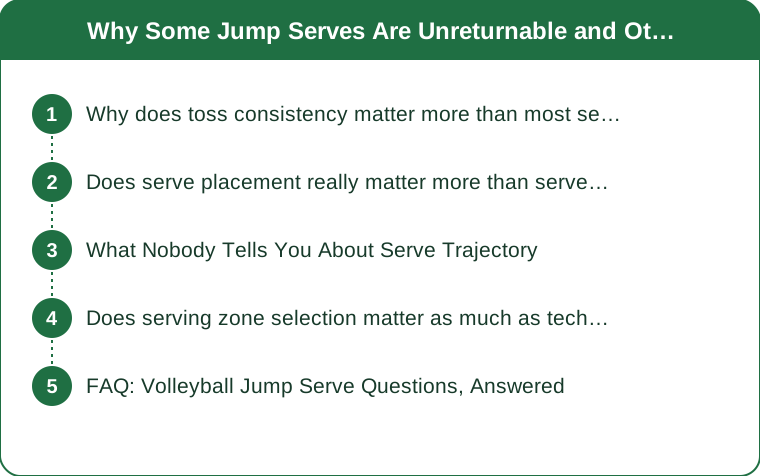
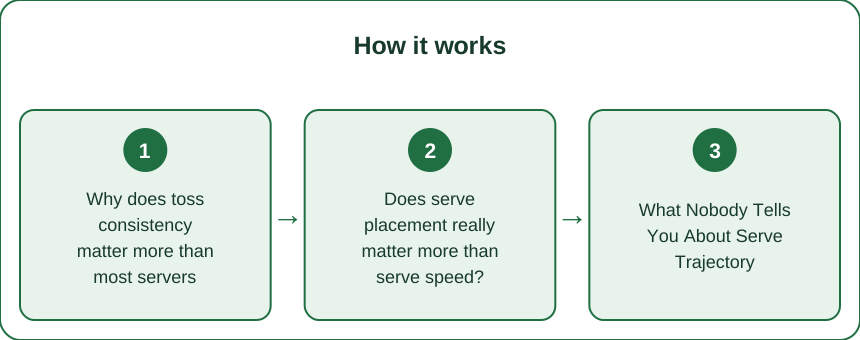
Why does toss consistency matter more than most servers realize?
Because a jump serve’s entire timing and contact point depends on a repeatable toss — a toss that varies in height or placement forces the server to adjust their approach and contact timing on the fly, which reduces both power transfer and, more importantly, the consistency that lets a server aim reliably at a chosen target rather than just hoping for a good result.
Does serve placement really matter more than serve speed?
In many cases, yes — serving to a seam between two receivers, or targeting a passer’s non-dominant shoulder side, disrupts passing structure more reliably than raw speed alone, since a hard serve hit directly at a well-positioned passer’s strong platform is often passed cleanly regardless of speed, while a well-placed medium-speed serve to a weak spot in the reception formation creates a harder dig even without maximum power.

What Nobody Tells You About Serve Trajectory
A jump serve’s downward trajectory angle (achieved by contacting the ball while still rising or at the peak of the jump, rather than on the way down) creates a passing angle that’s mechanically harder for a receiver to control than a flatter trajectory — this angle effect matters independently of both speed and placement, and it’s one of the harder technical elements to develop but among the most impactful.
Does serving zone selection matter as much as technique?
Yes — targeting a team’s weakest passer specifically, rather than serving generally to open court, is a strategic decision separate from the technical serve itself, and scouting or observing which player struggles most with reception during warmups or earlier in a match is a practical, low-effort way to improve serve effectiveness beyond technique alone.
FAQ: Volleyball Jump Serve Questions, Answered
How important is a consistent pre-serve routine for toss consistency?
Very — a repeatable routine (same number of steps, same toss release point) is one of the more reliable ways to build toss consistency, which underpins nearly everything else about serve effectiveness.
Should beginners prioritize learning a jump serve over a standing float serve?
Most coaches recommend mastering a consistent standing serve first, since it builds foundational contact and placement skills that transfer directly to jump serve development later.
Does serve receive difficulty change based on rotation or score situation?
Yes — targeting a team’s weaker passer becomes especially valuable in high-pressure score situations, where a difficult pass is more likely to lead directly to a point than the same serve earlier in a set.
TL;DR:
- Toss consistency, not swing power, is the foundation of a reliably effective jump serve
- Placement to seams or a passer’s weak side disrupts reception more than raw speed alone
- Contact timing at the peak of the jump creates a trajectory angle that’s mechanically harder to pass
- Targeting a team’s weakest passer is a strategic lever separate from serve technique itself
Develop toss consistency and placement before chasing more power — that combination is what actually separates unreturnable serves from just hard ones.
Keep Reading
This article is for general informational and styling purposes only. Fit, sizing, and product availability may vary.