Why Your Shoulder Feels Worse the Day After a Tournament Than During It
Quick Answer: Shoulder soreness that peaks the day after a tournament, rather than during it, is a normal delayed-onset pattern from repetitive overhead loading — adrenaline masks fatigue signals during play. A specific cool-down, ice, and mobility routine done within an hour of the last match meaningfully reduces next-day severity.
You played four matches back to back and felt fine — tired legs, sure, but the shoulder held up. Then you wake up the next morning and can barely reach for a coffee mug overhead. That gap between during and after is real, and it’s not a sign something went wrong mid-tournament.
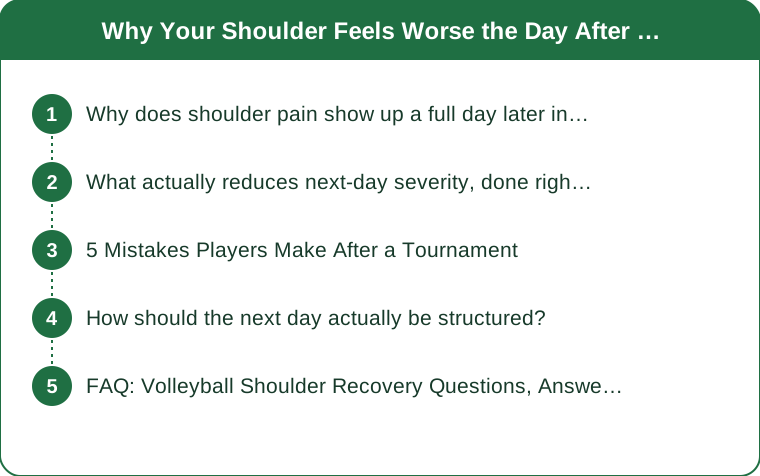
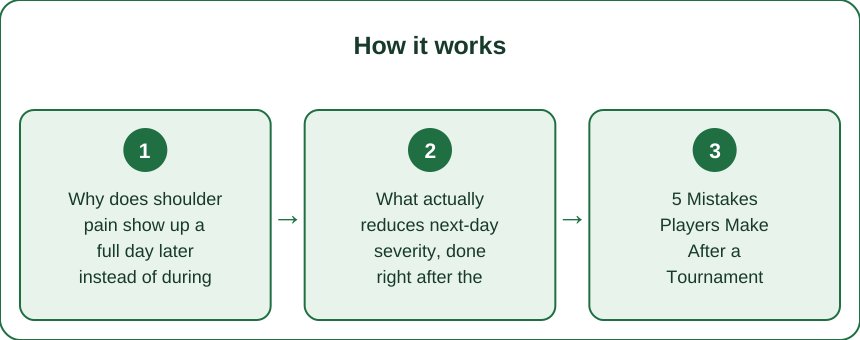
Why does shoulder pain show up a full day later instead of during play?
Adrenaline and competitive focus suppress pain and fatigue signals during a match, which is exactly why athletes can play through genuine tissue fatigue without noticing it in the moment. The inflammatory response driving next-day soreness (delayed onset muscle soreness, plus joint-specific fatigue from repetitive overhead loading) builds over the following 12-24 hours once that adrenaline buffer fades.
This is a normal pattern, not a sign the shoulder was overused specifically today versus other days — it’s the accumulated overhead load across the whole tournament catching up at once.
What actually reduces next-day severity, done right after the last match?
Ice for 15-20 minutes within the first hour after your final match blunts the inflammatory response before it fully develops, rather than trying to manage it after the fact the next morning. Gentle overhead mobility work — arm circles, band pull-aparts, light shoulder rolls — done the same evening keeps the joint moving through its range before stiffness sets in overnight.
5 Mistakes Players Make After a Tournament
1. Going straight from the last match to sitting still for hours (driving home, sitting at dinner) without any mobility work in between.
2. Skipping ice because the shoulder ‘feels fine’ right after playing — that’s the adrenaline talking, not the actual tissue state.
3. Sleeping on the playing-arm side the night of a tournament, adding compression to an already fatigued joint.
4. Jumping straight back into overhead training the next day instead of an active recovery day.
5. Ignoring one-sided fatigue — most players load one arm significantly more than the other across a tournament, and treating both shoulders identically in recovery misses this.
How should the next day actually be structured?
Light, non-overhead movement — walking, easy cycling, light lower-body work — rather than a full rest day or a return to hitting. Complete rest can leave the shoulder stiffer than gentle movement does, while jumping back into overhead-heavy training too soon compounds the still-developing inflammation.
If pain is sharp rather than a dull, generalized soreness, or it doesn’t meaningfully improve within 2-3 days, that’s worth a conversation with a physical therapist rather than continuing to self-manage.
FAQ: Volleyball Shoulder Recovery Questions, Answered
Is it normal for one shoulder to be more sore than the other after a tournament?
Yes — most players, especially hitters and servers, load their dominant arm significantly more across a tournament, so asymmetric soreness is expected rather than a red flag on its own.
How long should next-day shoulder soreness reasonably last?
Typically 2-4 days for a normal overhead-fatigue pattern; soreness extending well beyond that, or accompanied by sharp pain, is worth having assessed.
Does stretching help more than ice, or the other way around?
Both address different things — ice targets the inflammatory response, gentle mobility work maintains range of motion — using both together in the hours right after play tends to work better than either alone.
TL;DR:
- Adrenaline masks shoulder fatigue during play; soreness peaks 12-24 hours later as inflammation develops
- Ice within the first hour and gentle mobility work the same evening reduce next-day severity
- Avoid sleeping on the playing-arm side and skipping ice just because the shoulder felt fine post-match
- The next day calls for light, non-overhead movement — not full rest, not a return to hitting
The day-after soreness isn’t a sign anything went wrong — it’s the tournament’s real cost showing up on a delay, and a same-day routine changes how much of it you feel.
Keep Reading
This article is for general informational and styling purposes only. Fit, sizing, and product availability may vary.