Why Preseason Shoulder Pain Is a Volume Problem, Not a Technique Problem
Quick Answer: Most preseason shoulder pain is load spike, not bad mechanics. The jump from off-season hitting volume to full preseason is often a five to tenfold increase in a single week, and tendon tissue adapts far more slowly than muscle or fitness. Ramp hitting volume by roughly 10-20% per week, count your swings, and build posterior shoulder and scapular strength before the volume arrives.
August: twenty swings a week.
First week of preseason: four hundred.
Week two: your shoulder.
The technique you have had for three years did not suddenly go wrong.

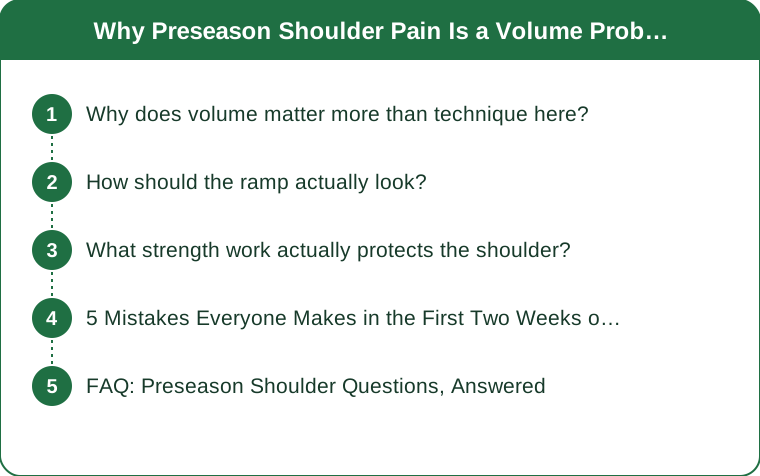
Why does volume matter more than technique here?
Because tendon adapts on a different timescale to everything else you train.
Muscle and cardiovascular fitness respond within days to weeks. Tendon remodelling is considerably slower, and the tissue that hurts in an overhead athlete’s shoulder — rotator cuff tendon, most often supraspinatus — is exactly the slow-adapting kind. So you can feel fit and strong while the specific tissue taking the load is still weeks behind.
Which means the rate of change is the risk factor, not the total. A player hitting 400 balls a week all season is often fine. That same player going from 20 to 400 in one week is the one who gets hurt. Sports-medicine work on training load consistently points to sharp increases relative to recent chronic load as the problem, across sports.
Technique still matters, and it matters differently. Poor mechanics raise the load per swing. But mechanics that were tolerable at low volume become intolerable at high volume — which is why the pain appears in preseason and people blame technique. The mechanics did not change. The multiplier did.
Fatigue is where the two meet. As you tire late in a session, mechanics degrade, so the last fifty swings of a long session carry more load per rep than the first fifty. This is why session structure matters as much as weekly totals.
How should the ramp actually look?
Concretely, with numbers you can count.
Count swings. Not sessions, not hours — actual full-effort overhead swings, including serves. Most players badly underestimate. A single scrimmage-heavy practice can be 150-200 swings, and serving is often the forgotten half of the total.
Increase by 10-20% per week. From 100 swings in week one that means roughly 115-120 in week two, not 300. It feels absurdly conservative for two weeks and then it feels correct.
Start ramping four to six weeks before preseason. This is the piece that makes the whole thing work, and it is the piece nobody does. Hitting a wall, serving into an empty gym, even 30-40 controlled swings twice a week in August builds the chronic load that makes the preseason jump survivable.
Cap hard swings in a single session. Spreading 400 weekly swings across five days is very different from 200 on Monday and 200 on Thursday, even though the total matches.
And separate serving from hitting in your count. A jump serve is a full-load overhead action. Twenty serves is not a warm-up; it is twenty swings.

What strength work actually protects the shoulder?
Five areas, and the popular one is the least important.
Posterior cuff strength — external rotation. Volleyball is overwhelmingly an internal-rotation sport, and the decelerating muscles on the back of the shoulder are what control the follow-through. Band external rotations, 2-3 sets of 12-15, three times a week, done with intent rather than as a warm-up afterthought.
Scapular control, especially lower trapezius and serratus. The shoulder blade has to rotate upward to give the arm room overhead. If it does not, the space narrows under load. Y-raises, wall slides and prone rows target this directly.
Thoracic spine mobility. A stiff mid-back means the shoulder has to find the last part of the range, and it usually finds it at the joint that can least afford it. Foam roller extensions and open-book rotations before every session.
Eccentric loading for the cuff. Slow lowering under control — 3-4 seconds — builds tendon capacity better than fast concentric-only work. This is where the actual tissue adaptation happens.
And general pulling strength. Rows, pull-downs, face pulls. The push:pull ratio in most volleyball players’ training is badly skewed toward pushing, and correcting that changes resting shoulder position.
None of this replaces medical care — pain that persists beyond a few days of load reduction, night pain, or weakness in the arm deserve assessment. This is general information, not medical advice.
5 Mistakes Everyone Makes in the First Two Weeks of Preseason
Doing nothing in the off-season and everything in week one. The whole article, in one sentence. Even minimal August volume changes the maths dramatically.
Not counting serves. Serving feels like a break from hitting. Your shoulder does not distinguish. Add serves to the swing count and most players discover their real volume is 40% higher than they thought.
Hitting through ‘just tightness’. Early tendon irritation genuinely does feel like tightness, and it genuinely does warm up and feel better after twenty balls — which is precisely why people keep hitting on it. Pain that disappears with warm-up and returns the next morning is the classic tendon pattern, not a sign it is fine.
Doing prehab after practice when tired. Band work at the end of a two-hour session is done badly or skipped. Move it to the morning or before practice, and it actually gets done properly.
And ignoring sleep in the ramp weeks. Tissue repair happens in sleep, and preseason usually coincides with a schedule change, early starts and a new term. Cutting sleep during the highest load spike of the year is the least visible mistake on this list and possibly the most costly.
FAQ: Preseason Shoulder Questions, Answered
How many swings is too many?
There is no universal number — it is relative to your recent weeks. More than about 20% above last week’s total is where risk climbs for most players.
When should I start ramping?
Four to six weeks before preseason, at low volume twice a week. This is the highest-value thing on the list.
Is shoulder pain normal in preseason?
Some soreness after a load increase is common. Pain that is sharp, wakes you at night, or persists beyond a few easy days is not — get it assessed.
Should I stop hitting entirely if it hurts?
Usually not necessary. Reducing volume by half and keeping the strength work is often more effective than complete rest, but that decision belongs with a physio who can see you.
What’s the single best exercise?
Band external rotation, done regularly and with control. Unglamorous, well supported, and almost nobody does enough of it.
Does technique coaching help?
Yes, for load per swing — particularly avoiding a hitting pattern that pulls the arm across the body on follow-through. But it will not rescue a volume spike.
Do serves really count as much as spikes?
A jump serve, essentially yes. A float serve is lower load but not zero. Count them all.
TL;DR:
- Preseason shoulder pain is usually a load spike, not a technique fault.
- Count swings including serves, and increase by 10-20% per week, not fivefold in one.
- Start ramping 4-6 weeks out — 30-40 controlled swings twice a week changes everything.
- Build external rotation, scapular control and thoracic mobility before the volume arrives, in the morning rather than after practice.
- Pain that warms up and returns next morning is the tendon pattern — that is a stop sign, not a green light.
Count your swings this week. The number is almost always higher than the guess.
Keep Reading
This article is for general informational and styling purposes only. Fit, sizing, and product availability may vary.