Moving From Sand to Indoor Volleyball: What Actually Changes
Quick Answer: The physical base you built in sand transfers well — sand builds ankle stability, jumping strength, and ball control. What does not transfer is timing. Indoor floors return energy that sand absorbs, so your approach comes in early and your landings are far harder on your joints. Expect one to two weeks of timing recalibration, and expect your shins and knees to complain first, not your lungs.
You spent the summer on sand and you have never felt fitter. Then your first indoor session, your approach arrived a half-beat early on every single ball and you jumped into the block twice.
Nothing has gone wrong. Your body is calibrated to a surface that no longer exists, and the second section explains exactly which part needs recalibrating.
What actually transfers from sand to indoor?
More than people expect, and it is worth knowing which parts to trust.
Leg strength transfers, strongly. Jumping in sand requires substantially more force to achieve less height, because the surface absorbs energy instead of returning it. A summer of sand jumping is genuinely a strength block. Most players find their standing reach numbers indoors improve after a beach season.
Ankle and foot stability transfers. The unstable surface loads the small stabilizers around the ankle and foot constantly. This is protective indoors.
Ball control transfers, and it is your biggest advantage. Beach volleyball’s smaller teams, softer ball, and wind mean you touch the ball more and in worse positions. Players coming from sand almost always have better reading, better platform control, and better emergency touches than their indoor-only teammates.
Conditioning transfers unevenly. Sand movement is harder per step but usually lower total volume than an indoor practice with long rallies and continuous drills. Expect your legs to be fine and your repeated-effort capacity to need a couple of weeks.
Communication and court sense transfer. Two-person play means you cover more court and make more decisions per point. Coming back to six, many players report the court feeling almost empty at first, in a good way.
Why is my timing off, and how long does it take to fix?
This is the real transition, and it is a timing problem, not a fitness one.
Sand takes time out of your approach. Each step sinks, so the last two steps of a beach approach take longer, and your body has spent a summer building an internal clock around that delay. Move onto a hard floor and every step returns you faster than expected, so you arrive early — jumping before the ball is where you want it, hitting on the way down, or drifting under it.
The plant is different. In sand, you cannot plant hard because the surface gives. Indoors, the last step is a firm, aggressive plant that converts horizontal speed into vertical height. Beach players often plant too softly for the first week and wonder why they are not jumping as high as they should be.
Blocking timing shifts most of all. Sand blocking involves a slower, more deliberate load; indoor blocking demands a fast lateral move and an immediate jump.
Realistic timeline: three to six sessions for approach timing, one to two weeks for blocking, and a month before it feels fully automatic. The fix is repetition specifically on approaches — not extra conditioning.
Practical drill: hit twenty balls off a stationary toss focusing purely on contacting at full extension. Ignore power entirely for the first sessions — you are recalibrating a clock, not building a swing.

What is going to hurt, and how do you prevent it?
Sand forgives landings. Indoor floors do not, and that is where the injuries come from.
Shin splints are the classic early-season complaint. You have gone from a surface that absorbs nearly all landing force to one that returns it, at high volume, in shoes rather than barefoot. Medial tibial stress is a load-rate problem, and the load rate just went up dramatically.
Patellar tendon pain (jumper’s knee) follows the same logic — more jumps at higher impact per landing, on legs that have not done it in months.
Ankle sprains rise indoors, counterintuitively. Sand rarely produces the classic landing-on-a-foot sprain because there is no foot to land on at the net in a two-person game and the surface gives. Indoor blocking at the net is where most volleyball ankle sprains happen.
Prevention that actually works:
Cap your first two weeks of jump volume. Roughly half of what you think you can handle. The limiting factor is your tendons, and they adapt slower than muscle.
Get your shoes sorted before the first session, not after. Court shoes lose midsole cushioning long before the outsole looks worn. If your shoes are over a season old, replace them before ramping volume.
Reintroduce landing mechanics deliberately — land on two feet where possible, absorb through the hips and knees, and do not land stiff-legged.
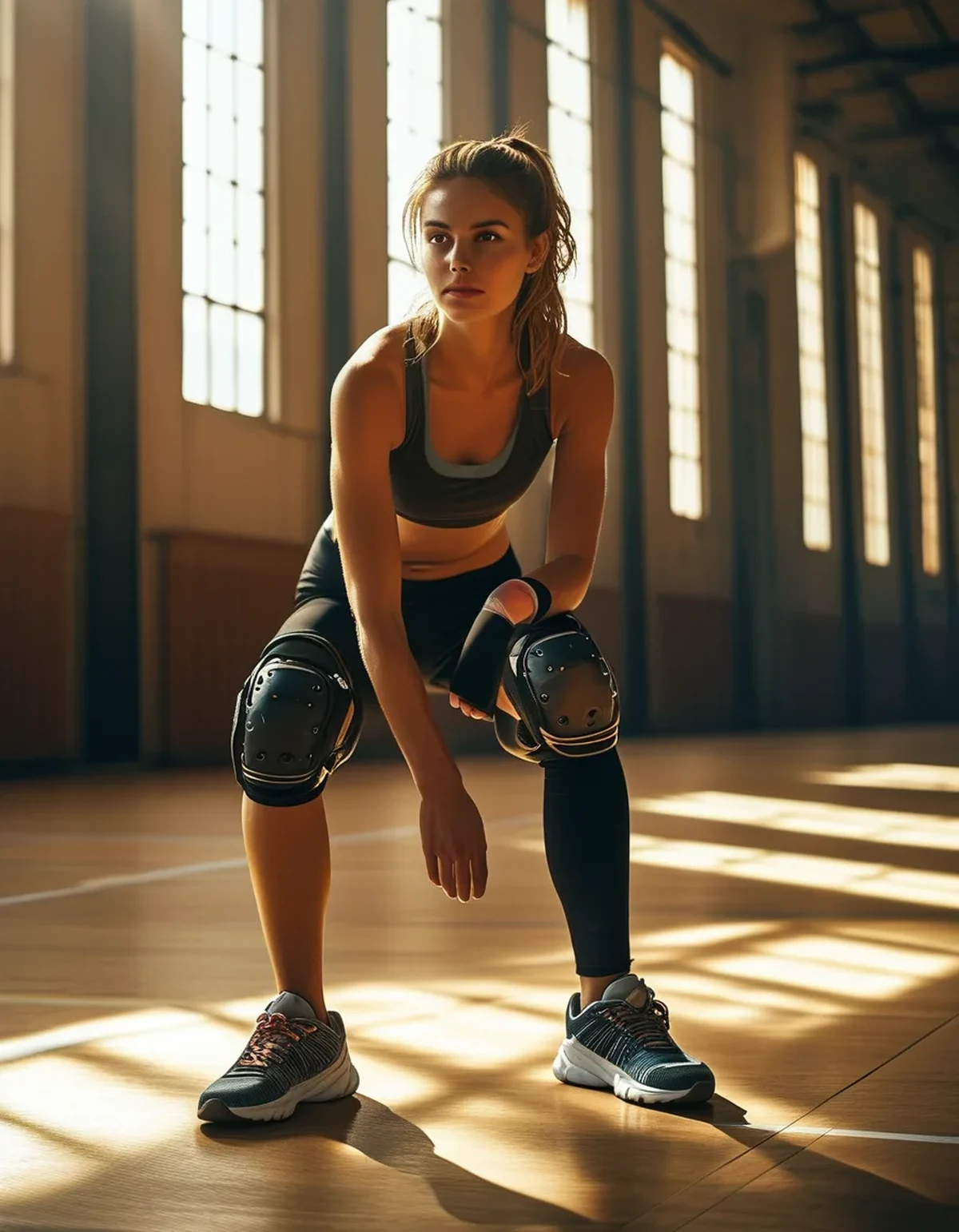
Knee pads from day one. Sand players often have not worn them all summer, and floor burns and a knocked patella are an unpleasant way to be reminded. If your shins hurt with a sharp, localized pain that persists at rest, get it assessed rather than training through it. This is general information, not medical advice.
Myth vs Fact: sand and indoor crossover
Myth: Beach players cannot hit hard indoors because sand ruins your swing.
Fact: The swing is fine — the approach is what needs work. Beach hitting emphasizes shot placement and control over pure power because the ball is softer and the wind matters. That is a tactical adaptation, not a mechanical loss. Once approach timing is recalibrated, the power comes back within a few sessions, usually higher than before because of the strength gains.
Myth: Sand training prevents injuries indoors.
Fact: It builds useful stability but does not prepare tissue for impact. The protective adaptations are real for ankles; the impact tolerance of your shins and knees is specifically not trained by sand, because sand exists precisely to absorb that impact. Ramp volume gradually regardless of how fit you feel.
Myth: You should jump higher immediately because sand was harder.
Fact: Usually there is a dip first, then a jump. The strength is there; the coordination to express it on a hard surface is not, yet. Most players see a small drop in the first week and a personal best within a month.
Myth: Indoor conditioning is easier.
Fact: It is different. Rally length and drill density indoors demand more repeated efforts. Your legs will be ready; your recovery between efforts may not be.
FAQ: Season Transition Questions, Answered
How long before my approach feels normal again?
Three to six focused sessions for the basic timing, about a month to full automaticity. The fastest route is deliberate approach repetition off predictable tosses rather than live play, because live play gives you too many variables to isolate the timing.
Should I keep playing sand during indoor season?
If you can, yes — a weekly sand session maintains the stability and ball-control benefits and is low-impact relative to indoor volume. The one caution is doing both at high volume in the same week during the first two weeks, when your tissue is adapting to the new impact load.
Do I need different shoes, or can I use trainers?
Court shoes, genuinely. Running shoes are built for forward motion with elevated, soft heels — exactly wrong for lateral movement and for the stability you need landing at the net. The elevated heel also increases ankle roll risk on a hard court. It is the single most worthwhile piece of kit for the transition.
TL;DR:
- Sand builds real jumping strength, ankle stability, and ball control — all of which transfer indoors.
- What does not transfer is timing: hard floors return energy sand absorbs, so approaches arrive early.
- Expect three to six sessions for approach timing and a month to feel fully automatic.
- Shins and knees take the hit, not your lungs — halve your jump volume for two weeks and replace old court shoes.
- Keep a weekly sand session if you can; it maintains the stability work at low impact.
The nicest part of the sand-to-indoor move is that the hard adaptation already happened over the summer. What is left is recalibration, which feels frustrating for a fortnight and then hands you a season built on legs that spent three months learning to jump out of a surface that gave nothing back.
Keep Reading
This article is for general informational and styling purposes only. Fit, sizing, and product availability may vary.