Why Your Serve Toss Drifts in an Air-Conditioned Gym
Quick Answer: A volleyball is light and large, which makes it unusually sensitive to moving air. A ceiling vent or floor unit produces a slow, invisible current that acts on the ball for the full second it is in the air, and the drift is largest at the top of the toss where the ball is slowest. Find the airflow before you blame your mechanics. Serve into it, not across it, when you have the choice.
Your toss is not inconsistent.
The air in that gym is, and a volleyball is the perfect instrument for detecting it.

Why is a volleyball so sensitive to gym airflow?
Because of the relationship between its size and its weight.
A volleyball has a large surface area and very little mass. That combination makes it responsive to small forces that would not move a heavier ball at all. A current you cannot feel on your skin can move a volleyball several inches over the course of a toss.
The toss is the most vulnerable moment. At the top of its arc the ball is nearly stationary, and a stationary ball has the longest exposure time to a sideways force. Drift is not evenly distributed through the toss - it concentrates precisely where you need accuracy.
Height multiplies the problem. A higher toss spends more time in the air and often rises into stronger airflow near ceiling vents. Jump servers with high tosses are affected most, which is why the best servers on a team often struggle most in a new gym.
The effect is directional and consistent. Unlike random error, vent drift pushes the same way every time in the same spot. If your misses share a direction, that is diagnostic - genuine mechanical inconsistency scatters.
Ceiling height changes it too. High-ceilinged gyms with big circulation systems produce larger, slower currents than small gyms with a single wall unit. Bigger halls, bigger drift, generally.
And it varies through the session. Systems cycle on and off, so a toss that was fine during the warm-up can drift in the second set. A mid-match change in your toss is a strong clue it was never your arm.
How do you find the airflow before it costs you a point?
Three quick tests, all doable during a warm-up.
Toss the ball straight up and watch it, without hitting. Do it three times from your serving spot and watch where it lands relative to your feet. A consistent directional drift is your answer in under a minute.
Look up for vents before you look at your technique. Ceiling diffusers, wall-mounted units, and open doors at the end lines are the usual sources. Standing under a diffuser at the service line is a common and entirely fixable situation.
Watch other people’s serves during the warm-up. If several players are missing in the same direction from the same end, it is the room. Shared error direction is the giveaway and it is visible from the bench.
Check both ends of the court separately. Airflow is rarely symmetrical, and the two service positions can behave completely differently. Assuming the ends match is the main reason people re-diagnose their serve at half time.
Notice open doors. A propped side door in warm weather creates a cross-draught across the whole hall, and it is the most common source in late summer. The draught arrives when someone gets hot and disappears when they close it.
And ask the home team. Regular players in that gym usually know exactly which corner is bad. It is not gamesmanship to ask, and most people will tell you.
What do you actually change once you know?
Small adjustments, and mostly to the toss rather than the swing.
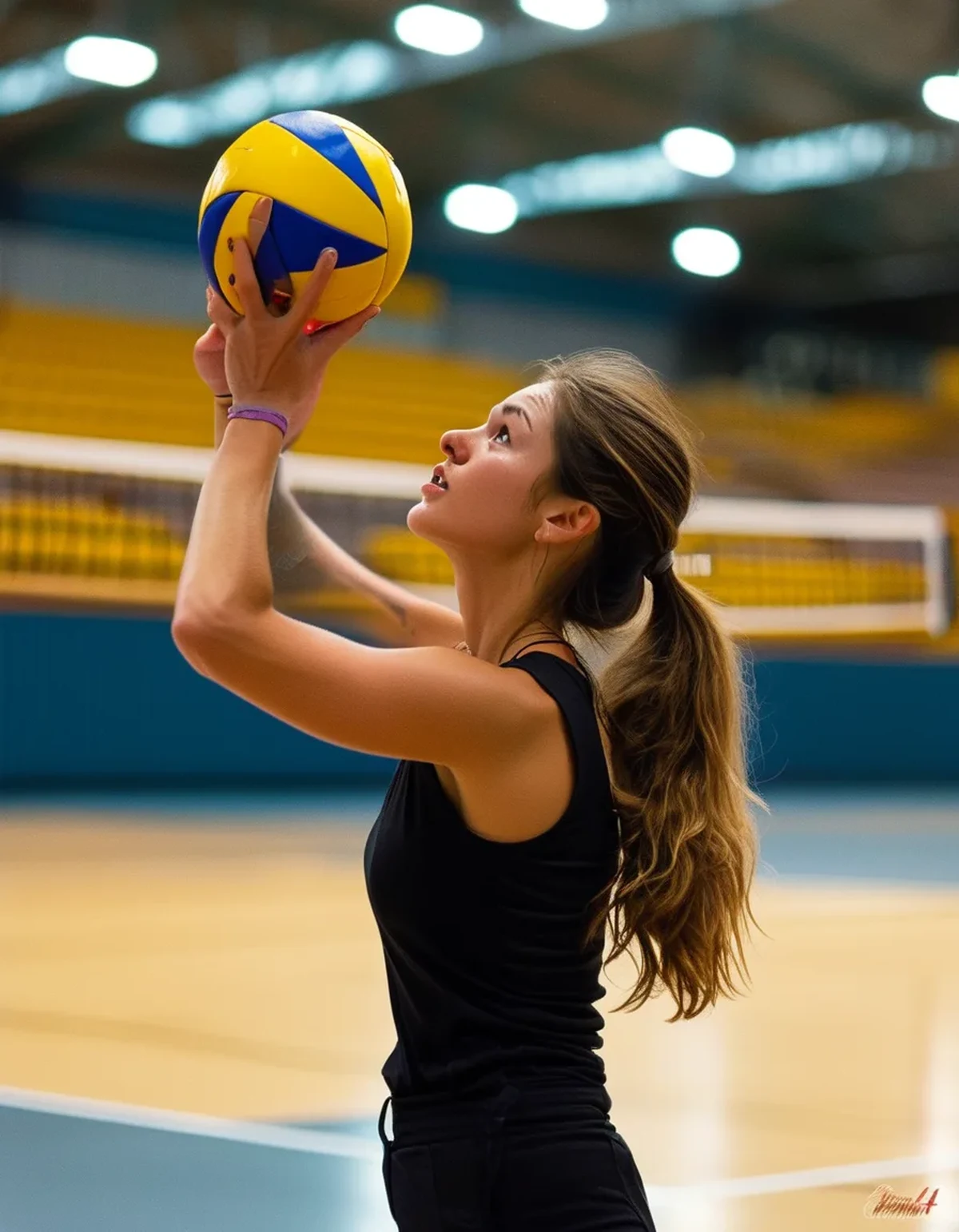
Lower the toss. Less time in the air means less drift, and a slightly lower toss costs less than an unpredictable one. This is the single most effective adjustment and the one most players resist.
Toss into the drift, not away from it. If the air pushes the ball toward the court, start it fractionally further back. Aim the toss so the drift delivers it to the right place, rather than fighting the current.
Move your starting position along the end line. A couple of steps sideways can take you out of a vent’s path entirely. Position is a legal and free adjustment and takes no technical change at all.
Switch to your more robust serve. If a jump serve requires a high toss and the high toss is unreliable in that gym, a jump float or a standing serve is the higher-percentage option. Serving in beats serving big in a difficult room.
Commit rather than adjust mid-toss. Reaching to correct a drifting ball produces a worse contact than accepting a slightly off toss. Decide the adjustment before the toss and then execute it.
And catch the bad ones early in a match. Most rules allow a re-toss on a serve; using it early while you calibrate is far cheaper than a service error. Use the re-toss deliberately rather than as an admission of failure.
Myth vs Fact: Serving Consistency Beliefs
Myth: a consistent toss should work in any gym. Fact: identical mechanics produce different ball paths in different air. The toss is consistent; the room is the variable, and treating it as your error leads to unnecessary technical changes.
Myth: a higher toss gives you more time and therefore more control. Fact: more air time means more exposure to drift and more accumulated error. Lower tosses are more repeatable in every condition, and the reason elite servers vary is style, not universal advantage.
Myth: indoor volleyball has no wind, so air is irrelevant. Fact: circulation systems, open doors, and large halls all produce meaningful currents. Indoor is calmer than beach, not still.
Myth: if it were the air, everyone would be affected equally. Fact: drift depends on toss height, position on the line, and serve type, all of which vary between players. Two players in the same gym can have completely different experiences.
Myth: ball pressure does not matter. Fact: a softer ball behaves differently in flight and off the hand, and gym balls vary considerably. Check the ball before rebuilding your serve - it is a thirty-second check.
Myth: float serves are unaffected because they already move. Fact: float serves depend on a clean, still-air knuckle effect, and a cross-current makes them less predictable rather than more. Floats are affected more, not less.
FAQ: Serve Toss Questions, Answered
How much can air really move a volleyball?
Enough to turn a good toss into an awkward one - several inches over a high toss is common under a vent. It is small in absolute terms and large relative to your contact window.
Should I change my serve type for one bad gym?
For a match that matters, yes. A serve you can land beats a serve that scores twice and errs four times, and the switch is temporary.
Why does it seem worse in the second set?
Because air systems cycle, doors open, and the hall warms up as it fills with people. The room is not the same room it was during the warm-up, which is why re-testing the toss at the change of ends is worth the twenty seconds.
TL;DR:
- A volleyball is large and light, which makes it unusually responsive to air you cannot feel.
- Drift concentrates at the top of the toss, where the ball is slowest and you need the most accuracy.
- Misses sharing a direction point to the room, not to your mechanics - scatter points to technique.
- Test with three straight-up tosses at each end during the warm-up, and look for vents and open doors.
- Lower the toss, toss into the drift, or move along the line - and switch serve types in a bad room.
Next time you warm up in an unfamiliar gym, toss three balls straight up and watch where they land. Twenty seconds, and you will know whether to adjust your position or your technique.
Keep Reading
This article is for general informational and styling purposes only. Fit, sizing, and product availability may vary.