Serving in Volleyball: From Getting It Over to Placing It Where They Aren't
The serve is volleyball’s only moment of total control — no pass to receive, no set to chase, just you and the toss — and the rec player who builds a reliable serve owns the game’s most learnable advantage. The serving guide: the ladder, the technique and the pressure.

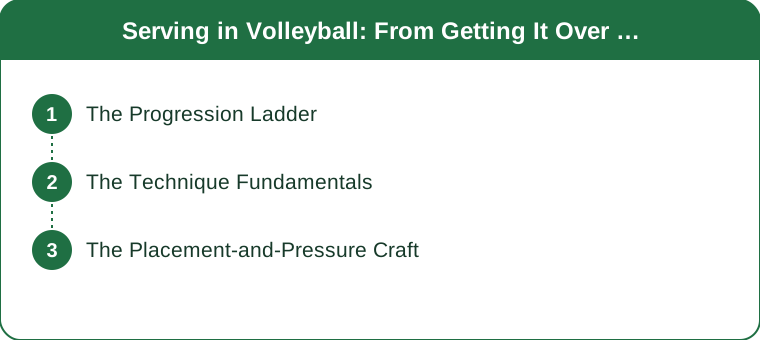
The Progression Ladder
Serve by serve: the underhand start (the legitimate beginner serve — the flat-hand strike from a stable stance; the over-the-net consistency being the only goal; the rec-league acceptance per the beginner doctrine), the overhand standing serve (the milestone serve — the toss-and-strike pattern below; the power arriving from technique, not arm per the technique doctrine), the float serve (the rec game’s best weapon — the no-spin strike that wobbles unpredictably; the contact-and-stop technique: the firm hand, the abrupt finish; the receiver’s nightmare at every level), the topspin option (the snap-wrist serve that dives — the aggressive tier after the float is reliable), the jump-serve honesty (the highlight serve being a years-later project — the risk-reward math per the progression doctrine), and the ladder rule (each serve at 90-percent consistency before the next — the missed serve being a free point gifted per the percentage doctrine).

The Technique Fundamentals
The overhand rebuilt: the toss supremacy (the serve being 80-percent toss — the consistent lift to the same spot: slightly in front of the hitting shoulder, just above reach; the toss practiced ALONE: the 50-toss sessions where the ball lands on a coin; the bad toss CAUGHT and redone, always per the toss doctrine), the stance-and-weight shift (the opposite-foot-forward stagger — the back-to-front weight transfer being the power source per the rotation doctrine), the contact craft (the firm open hand striking the middle-back of the ball — the high contact point; the follow-through toward the target for topspin, the stopped hand for float), the routine construction (the pre-serve ritual — the bounce-breathe-toss sequence from the ritual doctrine; the same routine every serve building the automaticity per the pressure doctrine), and the practice system (the serving being perfectly solo-practicable — the wall-and-court sessions from the solo doctrine; the 30-serve blocks with targets; the consistency-percentage tracked per the tracking doctrine).
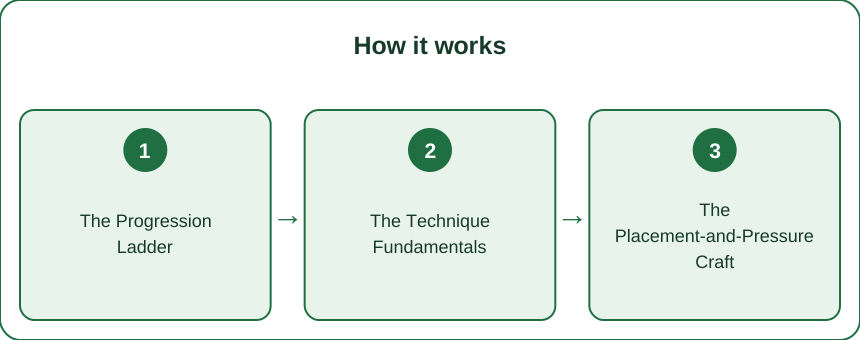
The Placement-and-Pressure Craft
Serving smart: the placement hierarchy (the deep serve beating the hard serve at rec level — the back-third targets pushing receivers off the net; the zone-targeting introduction: the corners and the seams between receivers per the strategy doctrine), the scouting-lite habit (the weak receiver noticed and served — the just-rotated player, the one hiding; the kind-but-competitive honesty of the tactic), the situational serving (the conservative serve at game point versus the aggressive serve when ahead — the risk budgeted per the pacing doctrine; the never-miss-after-a-timeout tradition), the pressure protocol (the routine as the anchor under nerves — the breath-and-ritual from the pressure doctrine; the missed-serve amnesia: the next serve unaffected per the mental doctrine), the serve-as-defense concept (the good serve making the opponent’s offense predictable — the serving being the rec game’s most undervalued skill), and the closing frame (the serve built in solo sessions cashing every game — the toss on a coin, the float that wobbles, the deep corner found; the only-you moment, owned). Toss on a coin, float to the deep corners, same ritual every time: the serve, built into a weapon.
The serve is 80-percent toss — practice the lift alone until it lands on a coin, and CATCH every bad toss. Climb the ladder at 90-percent consistency per rung: underhand, overhand, then the float (firm hand, abrupt stop — the rec game’s best weapon). Serve deep corners over hard, target the just-rotated receiver, and run the same ritual every time.
Keep Reading
This article is for general informational and styling purposes only. Fit, sizing, and product availability may vary.