How to Actually Prepare for a Volleyball Tryout, Not Just Show Up and Hope
Quick Answer: Coaches at tryouts are watching for consistency in fundamentals (passing platform, serving accuracy) more than flashy plays, plus coachability — how quickly you adjust when given feedback during the tryout itself. Spending prep time on serve consistency and passing platform reps pays off more than working on advanced skills you can’t yet execute reliably under pressure.
Most players walk into tryouts hoping their best individual play stands out. What actually gets noticed is whether your fundamentals hold up consistently across two hours of drills.

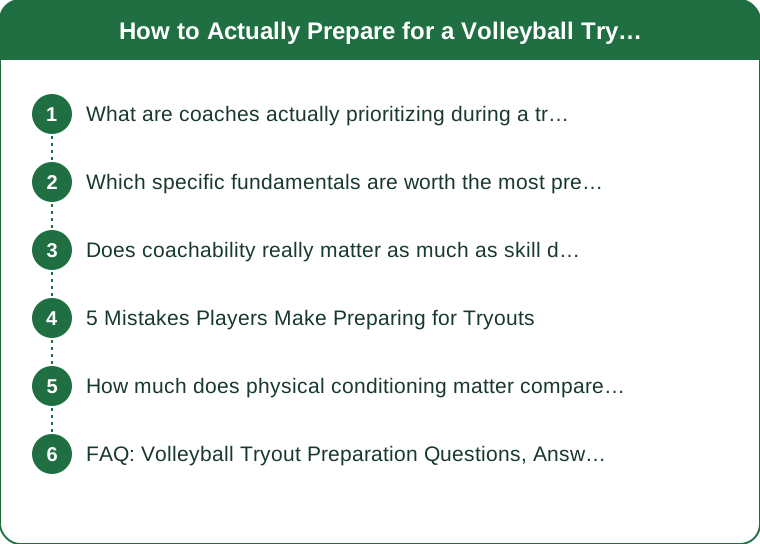
What are coaches actually prioritizing during a tryout — talent or consistency?
Consistency, especially in fundamentals, usually outweighs occasional flashes of talent in a tryout setting, because coaches are trying to predict how you’ll perform across a full season, not just in one good rep. A player who passes reliably and serves in consistently, even without spectacular power, often reads as more valuable than a player with occasional impressive plays surrounded by inconsistent execution.
This is genuinely good news for tryout prep — it means focused practice on a few specific fundamentals in the weeks before tryouts is a better use of time than trying to add flashy new skills you haven’t fully developed.
Which specific fundamentals are worth the most prep focus?
Serving consistency is one of the highest-value areas, since missed serves are one of the most visible, easily countable errors in a tryout setting — a player who serves in reliably, even at moderate power, often stands out simply by not handing over easy points. Passing platform consistency is the other major focus area, since first-contact quality determines how well the rest of a play can develop, and coaches watch it closely across many reps.
Spending prep time on these two areas specifically, rather than spreading practice thin across every skill, tends to produce the most visible improvement by tryout day.
Does coachability really matter as much as skill during a short tryout?
Often, yes — coaches know tryouts capture a small skill snapshot, but how a player responds to in-the-moment feedback or a corrected instruction gives real signal about how they’ll develop over a season, which matters for team selection beyond just current skill level. Visibly applying a coaching cue within the same drill, rather than repeating the same mistake, reads as a meaningfully positive sign.
This means it’s worth actively listening for and applying any feedback given during warmups or early drills, rather than treating tryout time purely as a chance to showcase existing skill.

5 Mistakes Players Make Preparing for Tryouts
1. Focusing prep time on advanced or flashy skills instead of fundamental consistency.
2. Not practicing serving under any pressure or fatigue before tryout day, when tryout serving often happens after tiring drills.
3. Arriving without warming up properly, leading to a rough, unrepresentative first few reps that color a coach’s early impression.
4. Being visibly frustrated with mistakes during the tryout itself, which reads as a coachability concern beyond the mistake itself.
5. Not asking a coach or experienced player beforehand what the tryout format actually emphasizes, when that information is often available and changes how to prioritize prep.
How much does physical conditioning matter compared to skill-specific prep?
It matters, but mostly as a way to keep skill execution consistent late into a tryout, rather than as a standalone selling point. A player whose passing and serving quality holds up in the final 20 minutes of a tiring tryout, when fatigue typically degrades technique, demonstrates something valuable that pure conditioning work alone doesn’t directly show — the conditioning is in service of maintaining skill consistency, not a separate goal.
FAQ: Volleyball Tryout Preparation Questions, Answered
How many weeks before a tryout should focused prep start?
Four to six weeks of focused fundamental practice is a reasonable general window, though even two to three focused weeks produces noticeable improvement in serve and pass consistency.
Should I try to show off my strongest, most advanced skill during a tryout?
Only if you can execute it reliably under tryout pressure — an inconsistent advanced skill is less valuable to show than a consistent fundamental one.
Is it bad to ask a coach a clarifying question during a tryout?
Generally no — a clear, relevant question asked at an appropriate moment often reads as engagement rather than a weakness.
TL;DR:
- Coaches usually weigh fundamental consistency more heavily than occasional standout plays
- Serving consistency and passing platform reps are the highest-value areas for tryout-specific prep
- Visibly applying in-the-moment coaching feedback signals coachability, which matters for team fit
- Conditioning matters mainly for keeping skill execution consistent through tryout fatigue, not as a standalone factor
Tryout prep isn’t about cramming new skills in the final weeks — it’s about making sure your fundamentals hold up reliably across two hours of drills, fatigue included.
Keep Reading
This article is for general informational and styling purposes only. Fit, sizing, and product availability may vary.