Why Your Approach Timing Breaks the Moment the Set Slows Down
Quick Answer: Most hitters learn one approach rhythm on a consistent set and never build a way to adjust it. When a set comes slower or higher, the fix is to delay your first step, not to slow your whole approach — the last two steps must stay explosive to preserve jump height. Practice starting your approach from three different distances so your body learns to absorb timing changes in the opening step.
You hit clean all through warm-ups. Then a set comes up a little higher, you arrive early, and you swing at a ball that is still a foot above your reach.

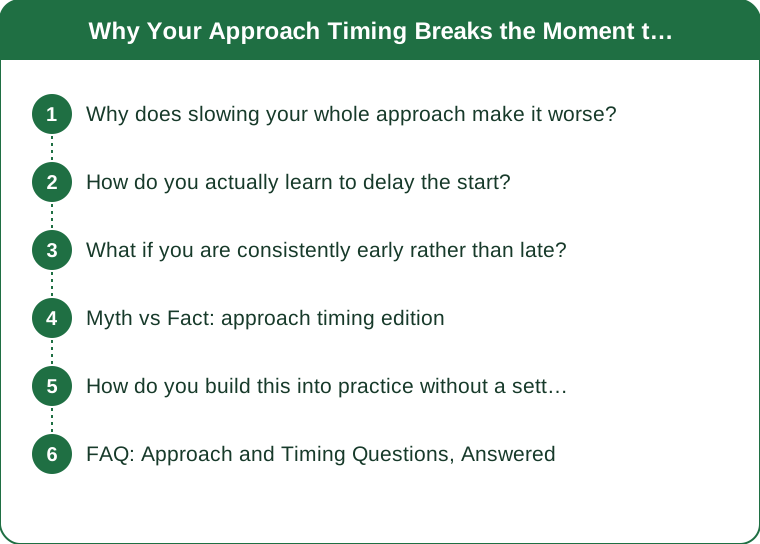
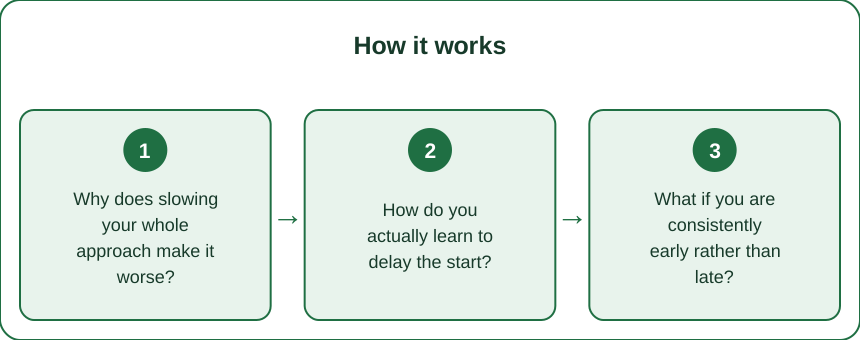
Why does slowing your whole approach make it worse?
Because your jump comes from the final two steps. In a standard four-step approach, the last two — the plant steps — convert horizontal momentum into vertical force. That conversion depends on speed.
When you slow the entire approach to wait for a high set, you arrive at the plant with less horizontal momentum to convert. The result is a lower jump, right at the moment the ball is higher than usual. That is the worst possible combination and it is why a slow approach on a high set feels so bad.
The correct adjustment happens at the beginning, not the end. Hold your starting position longer, then run the same approach at the same speed into the same explosive plant.
How do you actually learn to delay the start?
The problem is that most hitters start moving when they see the set leave the setter’s hands, which is a fixed cue for a variable outcome.
Better is to key off the ball’s apex. Start your approach as the ball reaches the top of its arc, not as it leaves the hands. A higher set has a later apex, so this cue self-adjusts without you having to consciously calculate anything.
For a fast set, this cue means you are moving almost immediately, which is correct. For a high outside set, it means a noticeable pause, which feels wrong until you have done it fifty times.
Drill it by having a setter deliberately alternate set heights without telling you which is coming. Ten reps of guessing wrong teaches the cue faster than any explanation.
What if you are consistently early rather than late?
Being early is more common than being late among developing hitters, because the instinct under pressure is to get there.
The first check is your starting distance from the net. If you start too close, you have nowhere to put the extra time and the only option is to slow down. Most hitters should start their approach further off the net than feels natural — around 10 to 12 feet for an outside attack.
The second check is your first step length. A short, tentative first step burns time without covering ground, so you end up needing to rush the last two. A committed long first step gives you a real adjustment window.
And a mental one: arriving early to a high ball is a decision you can still fix in the air by delaying your arm swing slightly. Arriving late is not fixable. If you must err, err early.

Myth vs Fact: approach timing edition
Myth: Good hitters have one perfect approach. Fact: Good hitters have one consistent plant and a highly variable start. The variability lives in the first step.
Myth: If the set is bad, the hit is not your responsibility. Fact: Adjusting to imperfect sets is most of what separates hitters at every level. Perfect sets are the exception in a real match.
Myth: You should jump straight up on a high set. Fact: You still want horizontal momentum converted vertically. A broad, fast approach into a strong plant produces more height than a standing jump, always.
Myth: Approach timing is fixed once you learn it. Fact: It changes with fatigue, with a different setter, and with court surface. Expect to recalibrate in the first few points of any match.
How do you build this into practice without a setter?
Self-toss work covers a surprising amount. Toss a ball high off the wall or into the air, then approach and swing, deliberately varying the toss height between reps.
Approach-only reps without a ball are worth more than they seem. Ten sets of five approaches, alternating between an immediate start and a two-count delayed start, builds the pattern without any hitting fatigue.
Film your approach from the side. Almost every hitter who thinks they are slowing only their first step is actually slowing the whole thing, and video is the only thing that settles it.
And train the approach when your legs are tired, at the end of practice. Timing that holds up fresh and collapses in the fifth set is the timing most matches are decided by.
FAQ: Approach and Timing Questions, Answered
Should I use a three-step or four-step approach?
Four-step gives more room for timing adjustment and generally produces higher jumps. Three-step is for tight situations — quick sets, back-row attacks with limited space, or when you are recovering from a dig.
Why is my timing worse on the right side than the left?
Usually footwork asymmetry. Most players drill the outside approach far more than the opposite-side one, so the non-dominant pattern is less automatic and less adaptable.
How long does it take to fix approach timing?
With deliberate variable-height practice, most players see real improvement within two to three weeks. The pattern is a motor skill, and motor skills respond to varied practice much faster than to repetitive identical reps.
TL;DR:
- Adjust timing with your first step, never by slowing the plant.
- Key your start off the ball’s apex, not the moment it leaves the setter’s hands.
- Start further from the net than feels natural so you have room to absorb changes.
- Practice with deliberately varied set heights, and do it while tired.
The hitters who look effortless against imperfect sets are not reading the ball better. They built an approach with an adjustable front end and a non-negotiable back end, and that is entirely learnable in a few weeks of intentional reps.
Keep Reading
This article is for general informational and styling purposes only. Fit, sizing, and product availability may vary.